
West Palm Beach Burglary Attorney
Burglary is one of the most seriously prosecuted property crimes in Florida. It is always charged as a felony, and depending on the circumstances, it can carry a sentence of up to life in prison. If you have been charged with burglary in South Florida, you need to know what the State must prove and where it may fall short.
Call Jeacoma Law today for a confidential consultation.
24/7
Emergency line
Free
Consultation
500+
Criminal Cases Defended
- BURGLARY IN FLORIDA
How Florida Defines Burglary
Under § 810.02, Fla. Stat., burglary is entering a dwelling, structure, or conveyance with the intent to commit an offense inside. Nothing has to be stolen, and no offense has to be completed. Force is not required either. Walking through an unlocked door with the wrong intent is enough.
An entry is not burglary if the premises were open to the public or you were licensed or invited to enter. That protection ends if you then remain inside with the intent to commit an offense, either surreptitiously or after permission has been withdrawn, or if you remain to commit or attempt a forcible felony. A lawful entry can still become a burglary.
The statute covers three types of places. A dwelling is any building or conveyance, including an attached porch, designed for people to lodge in at night; a structure is any building with a roof; and a conveyance includes motor vehicles, boats, trailers, railroad cars, and aircraft. Dwellings and structures also include the curtilage, the ground immediately around the building, when it has some form of enclosure. Entering a fenced yard with the intent to commit an offense constitutes burglary, even if you never go inside.
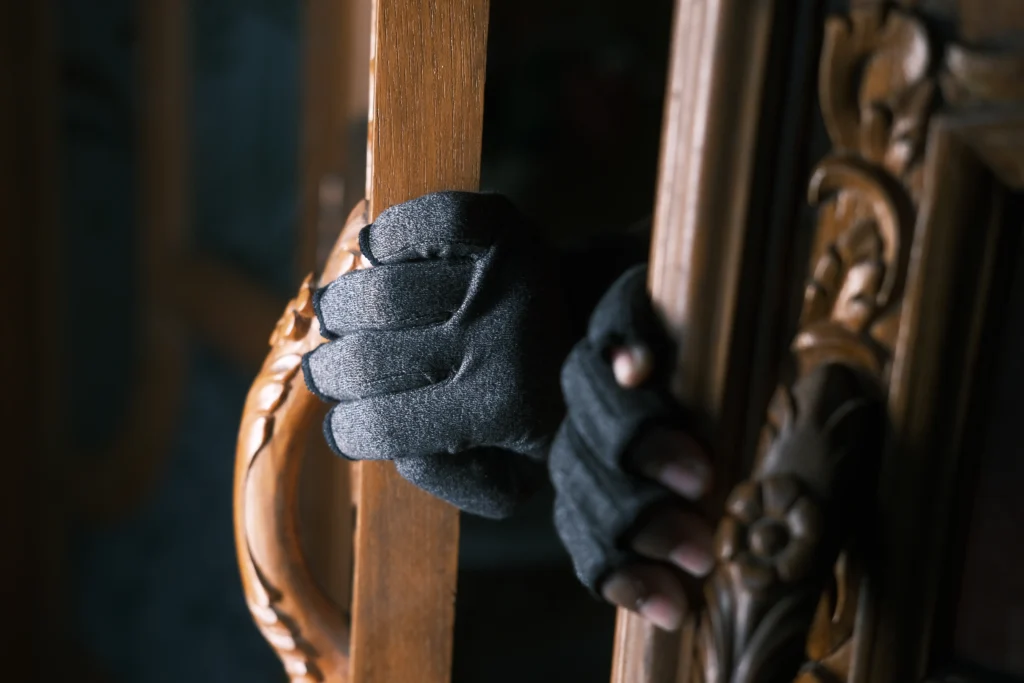
How Burglary Is Classified in Florida
Every burglary in Florida is a felony. What separates a five-year charge from a life charge is what the State can prove happened during the offense.
- First-Degree Felony (up to life in prison): A burglary becomes a first-degree felony if the offender assaults or batters anyone during the commission of the offense, or is or becomes armed with explosives or a dangerous weapon while inside. It is also a first-degree felony to burglarize a dwelling or structure and cause more than $1,000 in damage to the building or its contents, or to use a motor vehicle as a tool of the burglary, other than merely as a getaway vehicle, and to damage the dwelling or structure.
Second-Degree Felony (up to 15 years in prison): Without assault, battery, or a weapon, burglary of a dwelling is a second-degree felony whether or not anyone is home. The same degree applies to a structure or conveyance that has a person inside, to an authorized emergency vehicle, and to any structure or conveyance entered to steal a controlled substance
Third-Degree Felony (up to 5 years): Without assault, battery, or a weapon, burglary of an unoccupied structure or conveyance is a third-degree felony.
Two things can push the degree higher. A second- or third-degree burglary committed during a riot or a declared state of emergency, where the conditions made the burglary easier, is reclassified up one degree, and a person arrested for one is held until first appearance. If the offender actually possesses a firearm during the burglary, the 10-20-Life law sets a mandatory minimum of 10 years in prison, or 3 years for burglary of a conveyance, rising to 20 years if the firearm is discharged.
What the State Must Prove
To convict someone of burglary, the State must prove beyond a reasonable doubt that the defendant entered or remained in a dwelling, structure, or conveyance; that the entry or remaining was unlawful; and that at the time of entering, or while remaining, the defendant intended to commit an offense inside. The intended offense cannot be trespass or burglary itself.
Common Defenses
Lack of intent is often the most powerful defense available in a burglary case. If the defendant entered a location for a lawful reason, by mistake, or without any plan to commit an offense inside, the State cannot establish the intent element. Without intent, there is no burglary, though trespass charges may still apply. Be aware, though, Florida law makes proof of a stealthy entry without the owner’s consent prima facie evidence of intent. When the State relies on that inference, the defense has to answer it directly.
Consent or permission to enter goes to the heart of a charge based on unlawful entry. If you were invited in or otherwise licensed to be there, that is a defense. Consent is an affirmative defense: once the defense presents evidence of it, the State must prove beyond a reasonable doubt that you were not licensed or invited. Permission obtained by trick or deceit is not valid, and a lawful entry can still become burglary if the State proves one of the ways of unlawfully remaining.
Open to the public is a related defense. If the premises were open to the public at the time of entry, the entry is not burglary. That defense does not extend to areas of a business the defendant knew were closed to the public.
Misidentification arises frequently in burglary cases, particularly when the defendant was not caught at the scene. Surveillance footage, fingerprint evidence, and eyewitness identifications are all subject to challenge, and they can be less reliable than they appear.
Insufficient evidence applies when the State cannot connect the defendant to the offense through competent, admissible proof. Proximity to the scene, prior bad acts, or circumstantial evidence alone may not be enough to sustain a conviction.
Unlawful search and seizure can undermine the prosecution’s case if the evidence was obtained through a stop, search, or arrest that violated the defendant’s constitutional rights.
A Record That Cannot Be Sealed
A plea or finding of guilt for burglary of a dwelling cannot be sealed or expunged in Florida, even if adjudication is withheld. For that charge, the outcome of the case itself is the only protection for your record, which is why reductions and dismissals matter so much.
Talk to a Burglary Defense Attorney
A burglary conviction is a felony, and the penalties reflect that. Early intervention by an attorney gives you the best chance of a favorable outcome, whether that means a reduction, a dismissal, or a strong trial defense.
Andrew Jeacoma is a former Palm Beach County assistant public defender who tries cases, and he handles every matter personally. Call (561) 603-2203 for a confidential consultation. Serving clients throughout South Florida, including Palm Beach, Martin, and St. Lucie counties.
Related Offenses
Burglary charges often come alongside other charges. Theft, battery, assault, possession of burglary tools under § 810.06, and dealing in stolen property are all commonly charged in the same case. Possession of burglary tools is itself a third-degree felony. Each additional charge carries its own penalties and requires its own defense analysis.
If the alleged burglary involved a weapon or resulted in injury to another person, the exposure increases sharply, and the case needs attention now.
- Protect Your Future
Your Burglary Case Can't Wait
Call before the next hearing, not after. The consultation is free and confidential.